Home / Games
CS2 Gambling Games: Seven Game Types by Risk and House Edge
Seven ways to bet skins - how each works, what it costs and where to play it
Almost every CS2 gambling site is built from the same seven games. They differ in two things that matter to your balance: the house edge, which is the average share of each bet the site keeps, and the variance, which is how violently results swing around that average. A low-edge, low-variance game drains a bankroll slowly; a high-edge, high-variance one can empty it in minutes - or, rarely, multiply it. Pick the game first and the site second.
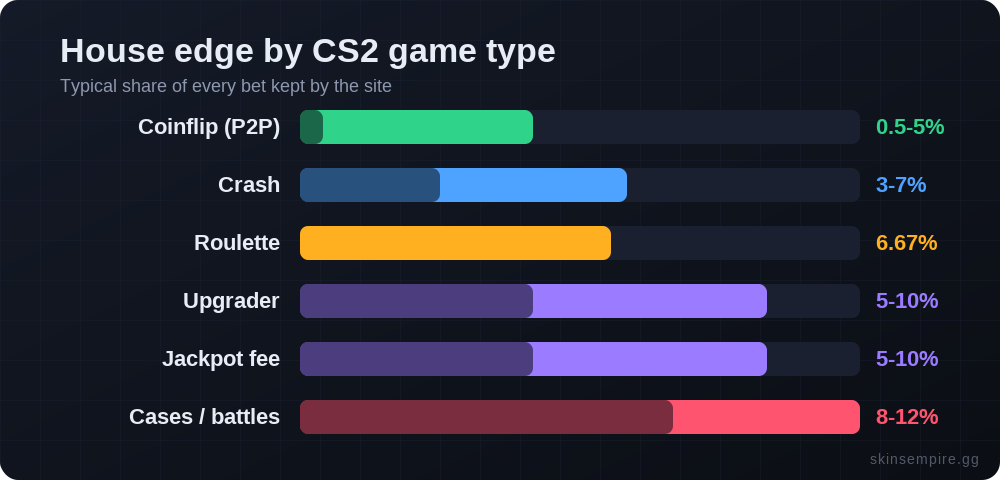
The table compares the seven types using figures operators publish or that follow from the game rules. Edges vary by site, so treat them as typical ranges and check the fairness page of the site you use. All gambling carries risk; none of these games can be beaten in the long run.
Crash
In crash, the multiplier begins at 1.00x, rises, and "crashes" at a random point.
Roulette
CS2 roulette is a stripped-down wheel with three outcomes instead of 37 numbers.
Case Opening
Case-opening sites sell their own cases - curated boxes of CS2 skins with a published price and drop table.
Coinflip
Coinflip is the simplest bet in skin gambling: two players put up matching value, a coin lands on one side, the winner takes both stakes minus the site's fee.
Case Battles
In a case battle, two to four players pay for the same set of cases, open them in sync, and whoever unboxes the most value keeps the whole pool.
Upgrader
An upgrader is a single transparent bet: you put in a skin or balance, pick a more valuable target, and the site shows your exact chance of success.
Jackpot
Jackpot is the original skin-gambling game.
Game types compared
| Game | Risk | Typical house edge | Skill element | Suits | Sites reviewed |
|---|---|---|---|---|---|
| Crash | High | 3-7% | Timing only | Multiplier hunters | 7 |
| Roulette | Medium | ~6.7% | None | Beginners | 6 |
| Case Opening | High | 8-12% | Choosing cases | Skin collectors | 7 |
| Coinflip | Medium | 0.5-5% | None | Low-edge players | 4 |
| Case Battles | Very high | 8-12% | Format choice | Competitive players | 5 |
| Upgrader | High | 5-10% | None | Players targeting one skin | 1 |
| Jackpot | Very high | 5-10% fee | Stake sizing | Social, big-pot players | 3 |
Which game type is right for you?
You are new and want your balance to last
Start with coinflip or roulette on red/black-style bets. Outcomes are close to 50/50 and the rules take one round to learn.
You want a specific skin
Do not gamble for it - buy it. If you still want the thrill, an upgrader shows the exact chance of hitting that one item, which cases never do.
You play with friends
Case battles and jackpot are the social modes: you play against people, not the house.
You are chasing one big multiplier
Crash with a high auto cash-out is the most direct way to bet small for a large multiple - and to lose most rounds while you wait.
The seven games side by side
| Game | Opponent | Site's income | Typical cost per $100 wagered | Round length | What you decide |
|---|---|---|---|---|---|
| Coinflip | One player | Commission | $0.50-$5 | Seconds | Stake |
| Crash | The house | Built-in edge | $3-$7 | 10-30 s | Target, stake |
| Roulette | The house | Built-in edge | about $6.67 | 20-30 s | Colour, stake |
| Upgrader | The house | Built-in edge | $5-$10 | Seconds | Input, target |
| Jackpot | Many players | Commission | $5-$10 | 30-90 s | Stake (your share) |
| Case opening | The house | Case pricing | $8-$12 | Seconds | Which case |
| Case battles | Other players (house in the cases) | Case pricing | $8-$12 | 1-3 min | Cases, lobby size, format |
Two patterns stand out. The games where you play other people - coinflip and jackpot - are priced by a commission, which can be very low (coinflip at a cheap site) or quite high (most jackpots). The games where you play the house are priced by an edge built into payouts, from a few percent on crash to around ten on cases.
Cost per hour, not just cost per bet
Edge per bet is only half the picture. Faster games put more bets through each hour. The table assumes a $1 stake and a typical pace.
| Game | Bets per hour (typical) | Turnover per hour | Typical edge | Expected cost per hour |
|---|---|---|---|---|
| Coinflip at 0.5% | 60 | $60 | 0.5% | about $0.30 |
| Crash at 4% | 150 | $150 | 4% | about $6 |
| Roulette at 6.67% | 140 | $140 | 6.67% | about $9.30 |
| Upgrader at 8% | 120 | $120 | 8% | about $9.60 |
| Case opening at 10% | 200 | $200 | 10% | about $20 |
| Jackpot at 8% | 50 | $50 | 8% | about $4 |
The figures are rough and your pace will differ, but the order is telling. Case opening at speed is the most expensive way to spend an hour; low-fee coinflip is by far the cheapest.
Variance: the other half of the choice
| Game | Variance | What a session usually looks like |
|---|---|---|
| Coinflip | Medium | Results swing evenly either way |
| Crash, low target | Low to medium | Frequent small wins, occasional busts |
| Crash, high target | Very high | Long droughts, rare big wins |
| Roulette, colours | Medium | Slow drift with streaks |
| Roulette, bonus slot | Very high | Long gaps between 14x hits |
| Upgrader | High | Most upgrades fail; occasional large jump |
| Jackpot, small share | Very high | Mostly losses, rare big pot |
| Case opening | High | Most openings below price, rare big drop |
| Case battles, 4 players | Very high | Win roughly one in four, big swings |
Choose variance to match your temperament and budget. If losing streaks upset you, low-variance formats will keep sessions calmer for the same expected cost.
Provably fair: what it covers in each game
| Game | What the system proves | What it does not prove |
|---|---|---|
| Crash | The crash point was fixed before betting | That the edge is low |
| Roulette | The slot was fixed before betting | That the wheel layout is favourable |
| Coinflip | The result was fixed when the lobby opened | That item valuations are fair |
| Jackpot | The winning ticket followed from seeds and the final total | That the commission is reasonable |
| Cases and battles | Each opening followed the listed chances | That item values match the market |
| Upgrader | The spin followed the displayed chance | That valuations are fair |
In every case, verification protects you from tampering, not from the price of the game. Read the second column and the third together.
Matching a game to your goal
"I want my balance to last as long as possible." Low-fee coinflip, or crash with a low auto cash-out. Both keep expected cost per hour small and results relatively steady.
"I want a chance at a big win from a small stake." Crash with a high target, the roulette bonus slot, or a single upgrade with a low displayed chance. Expect most sessions to end with nothing; size stakes so that is acceptable.
"I want to collect skins." Case opening - but read the drop table, value the common items and remember that buying the skin is nearly always cheaper.
"I want to play with friends." Case battles in team or group format, or a jackpot room with friends at similar stakes.
"I want to bet on Counter-Strike itself." Match betting at a sportsbook such as BC.Game, Gamdom or CSGO500, or the match tab at CSGOEmpire.
How games appeared in skin gambling, in order
| Period | Games that defined it |
|---|---|
| 2015 | Jackpot pots, early colour roulette |
| 2016 | Coinflip, crash; Valve acts against gambling sites mid-year |
| 2017-2019 | Third-party case opening grows; roulette and crash become standard |
| 2020s | Case battles and upgraders spread; crypto casinos add originals and esports betting |
Each new format added variety rather than replacing the last, which is why most large sites today offer four or five of these games side by side.
How to compare the same game across sites
When two sites offer the same game, the differences that matter are few and checkable:
- The price - a published edge or commission, or one you can calculate from the rules.
- Verification - whether you can check any past round.
- Valuations - for skin-based games, how the site values items relative to the market.
- Payments - how easily and cheaply you can withdraw.
- Licence and operator - who you are trusting with your balance.
Our individual game guides compare the sites we review on these points. Our review method explains how the same factors feed into each site's overall score.
Five rules that apply to every game
- Know the price of the game before your first bet.
- Set your stake from your budget, not from your last result.
- Decide when the session ends before it starts.
- Verify at least one round on every new site.
- Withdraw something early to test the route.
Frequently asked about game types
Which game is best for beginners? Low-stake coinflip or roulette colour bets: the rules are learned in one round and outcomes are close to even.
Which game has the best odds? Coinflip at a low-commission site, because the cost is the smallest. No game has positive expected value for players.
Are skill games available? Not in the sense of beating the house. Choices about stake, target and stopping affect variance and cost per hour, not the edge.
Why do sites push case battles and crash? They are fast, social and visually exciting, which keeps players engaged. That is good for the site's turnover.
Can I play these games without depositing? Free welcome cases and chat rain let you try several games with a small balance; see our promo codes.
The psychology built into fast games
All seven games share design features that make it easier to keep playing than to stop. Knowing them does not make you immune, but it makes them easier to notice.
Near-misses. A crash curve that busts just after your target, a case reel that stops one slot from a knife, an upgrade pointer just outside the arc. Near-misses feel like progress; mathematically they are ordinary losses.
Losses disguised as wins. Opening a $5 case and receiving a $2 item comes with the same animation and sound as a real win, even though you lost $3.
Visible winners. Chat and live feeds show other people's big wins. They do not show the far larger number of losses behind them.
Speed. Short rounds leave little time between decisions. The faster a game, the more turnover per hour - and the higher the hourly cost.
Small units. Coins, chips and site balances make stakes feel smaller than the same amount in your own currency.
Countermeasures are simple and effective: auto cash-out instead of manual, sounds off, a written session plan, and converting balances to real money whenever you check them.
Choosing a game by budget
| Monthly budget for gambling | Games that fit comfortably | Approach |
|---|---|---|
| Under $20 | Free welcome cases, low-stake coinflip, low-stake roulette | Play the free value; deposit little or nothing |
| $20-$100 | Coinflip, roulette, crash at low targets, cheap cases | Flat stakes of 1-2% of budget |
| $100-$500 | All games, with battles and upgrades as occasional treats | Session limits; avoid escalating stakes |
| Above $500 | All games; consider rakeback programmes | Track turnover monthly; review whether the spend still feels right |
The highest budget row deserves a second look every month. If the number keeps rising, the budget is no longer setting the play.
Games and the law
The legal position of each game type follows the legal position of gambling with skins in your country. Some jurisdictions treat skins as having monetary value, which brings skin gambling under gambling law; some regulate certain formats more strictly than others; many sites simply block entire countries. None of the sites in our list holds a licence from a strict regulator such as the UK Gambling Commission or the Malta Gaming Authority. Before you play any of these games, check that gambling with skins or crypto is permitted where you live, and never use a VPN to get around a block - it puts the whole balance at risk.
Glossary of game-type terms
- House edge - the average share of each bet a house game keeps.
- Commission / rake - the site's cut in player-versus-player games.
- RTP - return to player; 100% minus the edge.
- Variance - how widely results spread around the average.
- Turnover - total amount wagered, including recycled winnings.
- Provably fair - a system that lets you verify each result was fixed before you played.
- Multiplier - the factor by which a winning stake is paid.
Responsible play across all game types
Whatever you play, three settings do more than any strategy: a deposit limit for the week or month, a session length you decide before starting, and a rule never to raise stakes after a loss. Every site in our list provides some combination of limits, cool-off periods and self-exclusion, usually through support. If gambling stops being entertainment, the organisations on our responsible gambling page offer free, confidential help.
Each game in one paragraph
Crash. A multiplier climbs from 1.00x until it busts at a point fixed before the round. You choose when to cash out - ideally with an automatic target. Every target has the same expected return; higher targets simply win less often. Typical edges of 3-7% make it a mid-priced game, and its speed means turnover builds quickly. Full crash guide.
Roulette. A colour wheel - usually fifteen slots with two colours and one bonus slot - spins every 20-30 seconds. Colours pay 2x, the bonus slot 14x, and on the standard layout every bet carries a 6.67% edge. Easy to learn and easy to verify, it is also faster than it looks. Full roulette guide.
Case opening. You buy a site-made case and receive one item from its drop table. The case price sits above the expected value of its contents, typically by 8-12%. The common items, not the rare ones in the thumbnail, decide what most openings return. Full case opening guide.
Coinflip. Two players stake similar value; a coin decides; the winner takes both stakes minus a commission. With a low commission it is the cheapest game in skin gambling, and its main risk is that low cost per flip encourages large or numerous flips. Full coinflip guide.
Case battles. Two to four players open the same cases in sync and the highest (or lowest) total takes everything. The edge is that of the cases; the lobby size sets how lumpy the results are. Full case battles guide.
Upgrader. You risk an item or balance for a more valuable target at a displayed chance. The chance is slightly below the value ratio, which reveals the edge. It is the most transparent long shot available - and still a long shot. Full upgrader guide.
Jackpot. Players add value to a shared pot and one ticket wins it, with each player's chance equal to their share. The site's commission is the cost. Social and spectacular, it now runs mainly on unlicensed sites. Full jackpot guide.
Where each game is offered
| Site | Crash | Roulette | Cases | Coinflip | Battles | Upgrader | Jackpot |
|---|---|---|---|---|---|---|---|
| CSGOEmpire | - | Yes | Yes | Yes | Yes | - | - |
| CSGORoll | Yes | Yes | Yes | Yes | Yes | - | - |
| CSGO500 | Yes | Yes | Yes | - | Yes | Yes | - |
| Gamdom | Yes | Yes | Yes | - | - | - | - |
| BC.Game | Yes | - | - | - | - | - | - |
| Rainbet | Yes | - | - | - | - | - | - |
| CSGOLuck | Yes | Yes | Yes | Yes | Yes | - | Yes |
| CSGOBig | - | - | Yes | Yes | - | - | Yes |
| CSGOFast | Yes | Yes | Yes | - | Yes | - | Yes |
The table lists the game types we track for each site; many also run other originals such as dice, mines and plinko, and the crypto casinos add slots, live tables and sportsbooks.
How we chose these seven game types
We cover the formats that a CS2 player meets on almost every skin site and on the CS-focused areas of crypto casinos: games where skins or skin-funded balances are staked directly, and games inherited from the skin era. Slots, live dealer tables and sportsbooks are covered inside our individual site reviews, because their rules come from third-party providers and standard casino maths rather than from skin gambling.
The game pages are updated when sites change their formats or publish new figures; each one shows which reviewed sites currently offer the game. If you notice a site adding or removing a game type, let us know through the contact page.
All figures on this page are typical ranges; each site's own rules and fairness pages are the final word on its games.
For the costs of every game type on one scale, read our house edge guide; for how to verify any round, see provably fair explained; and for sizing stakes, see bankroll management.
Key takeaways
- Choose the game first, then the site.
- Price per bet and bets per hour together set your hourly cost.
- Player-versus-player games are priced by commission, house games by edge.
- Provably fair protects against tampering, not against the price.
- Set stake, session length and stop rules before you start.
- Free welcome cases let you try several game types before depositing anything.
- Every site in our list offers some form of limits or self-exclusion through support; use them before you need them.
Frequently asked questions
Which CS2 gambling game has the lowest house edge?
Peer-to-peer coinflip on sites that charge a small commission is usually the cheapest, followed by sportsbook-style match betting and crash. Case opening and case battles are normally the most expensive.
Are CS2 gambling games rigged?
On sites with a provably fair system you can verify that each result was fixed before you bet. That proves the round was not altered; it does not remove the house edge.
Can skill improve my results?
Only marginally. Bet sizing and choosing low-edge games slow your losses; no strategy changes the expected value of a round.
What is the riskiest game type?
Case battles and high-multiplier crash have the highest variance: long losing streaks are normal.