Home / Blog / House Edge in CS2 Gambling: Every Game Compared
House Edge in CS2 Gambling: Every Game Compared
Guides
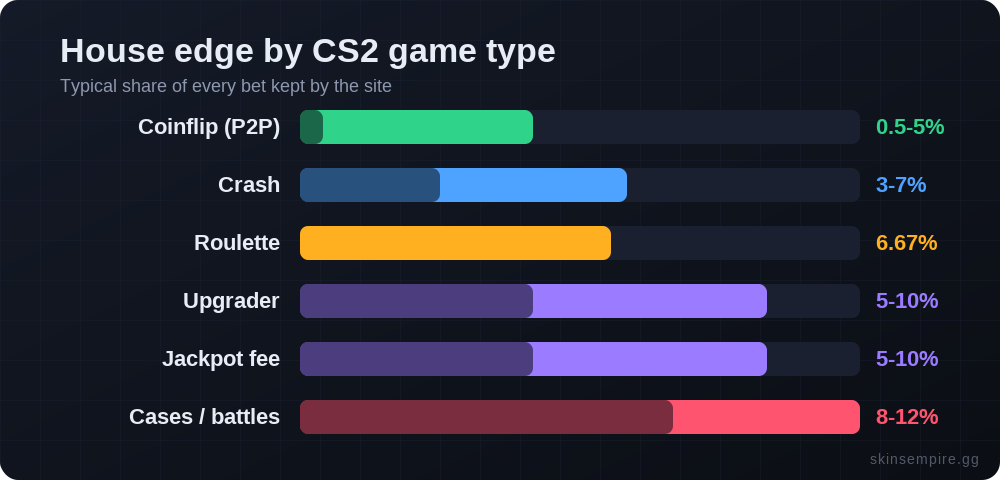
The house edge is the average share of every bet that a game keeps. It is the price of playing, and unlike luck it is the same for everyone. Knowing it will not make you win, but it tells you how long your balance should last - and which games are quietly three times as expensive as others.
The numbers
| Game | Typical edge | Cost per $100 wagered | Where the edge comes from |
|---|---|---|---|
| Coinflip (P2P) | 0.5-5% | $0.50-$5 | Commission on the pot |
| Crash | 3-7% | $3-$7 | Rounds that bust at or near 1.00x |
| Roulette (15-slot) | 6.67% | $6.67 | The single bonus slot |
| Upgrader | 5-10% | $5-$10 | Displayed chance below the value ratio |
| Jackpot | 5-10% | $5-$10 | Fee taken from the pot |
| Case opening / battles | 8-12% | $8-$12 | Case price above expected drop value |
These are typical ranges. Some operators publish exact figures - CSGOEmpire, for example, lists about 6.67% for roulette, roughly 8.8% for cases and a coinflip commission of around 0.5% - and many publish nothing, in which case you can often derive the number from the rules.
Working out roulette by hand
A standard CS2 wheel has 15 slots. A colour covers 7 of them and pays 2x. Your expected return on a $1 bet is 7/15 x $2 = $0.933. The missing 6.67 cents is the edge. The 14x bonus slot gives 1/15 x $14 = $0.933 as well: same price, wilder ride.
Edge is charged on turnover, not on deposits
This is the part that surprises people. If you deposit $50 and re-bet your balance until you have placed $500 in total bets on roulette, your expected loss is 6.67% of $500 - about $33 - not 6.67% of $50. Fast games multiply turnover: a crash round every ten seconds can push thousands of dollars of bets through a small balance in an evening.
Variance hides the edge in the short run
Over twenty bets, luck dominates and almost anything can happen. Over two thousand, results crowd around the edge. That is why short sessions feel beatable and long ones do not - and why "I was up for an hour" is not evidence of a system.
Bonuses and rakeback change the price slightly
Rakeback returns part of the edge: 15% rakeback on a 5% edge game lowers the effective edge to 4.25%. Free cases and no-wager rewards are a small one-off credit. Large deposit matches look better than they are, because the wagering attached to them generates more turnover - and more edge - than the bonus is worth. Our bonus pages describe how each offer actually pays.
How to use this
Choose the game you enjoy, then choose the cheapest version of it. Prefer sites that print their edges, keep stakes small relative to your balance, and decide on a loss limit before the first bet. If limits are hard to keep, the responsible gambling page lists free help.
Edge, RTP and commission: three names for one idea
House edge is the share of each bet the operator keeps on average. Return to player (RTP) is the share it gives back: 100% minus the edge. Commission is how player-versus-player games charge the same cost - instead of building it into payouts, the site takes a cut of the pot. A 5% edge, a 95% RTP and a 5% commission on the pot are, for your bankroll, roughly the same thing.
| Term | Typical form | Where you see it |
|---|---|---|
| House edge | "Edge: 4%" | Crash, roulette, dice, upgraders |
| RTP | "RTP: 96%" | Slots, case pages on some sites |
| Commission | "5% fee on the pot" | Coinflip, jackpot |
| Margin | Built into odds | Sports and esports betting |
How bookmaker margins compare
Betting on CS2 matches has its own version of the edge. Convert both sides' odds to implied probabilities (1 divided by the decimal odds) and add them; anything above 100% is the margin.
| Odds offered | Implied probabilities | Total | Margin |
|---|---|---|---|
| 1.90 / 1.90 | 52.6% + 52.6% | 105.3% | about 5% |
| 1.95 / 1.85 | 51.3% + 54.1% | 105.4% | about 5% |
| 1.50 / 2.50 | 66.7% + 40.0% | 106.7% | about 6% |
| 1.25 / 3.75 | 80.0% + 26.7% | 106.7% | about 6% |
Margins of 4-7% on main markets are common, with higher margins on niche or live markets. That puts match betting between crash and roulette in cost per bet - but with far fewer bets per hour.
Why the same edge feels different in different games
Two games with the same edge can produce very different sessions. Variance decides how results spread around the average. A 2x crash target and a roulette colour bet are both near-even, low-variance bets: results stay close to expectation over a session. A 50x crash target or the roulette bonus slot have the same edge per bet but huge variance: most sessions lose steadily, a few win big. Players often remember the big wins and misjudge the cost; the edge, quietly, is identical.
| Bet | Edge | Variance | What a 200-bet session usually looks like |
|---|---|---|---|
| Crash at 2x | about 4% | Low-medium | Close to -4% of turnover |
| Roulette colour | 6.67% | Medium | Close to -6.67%, with streaks |
| Roulette bonus slot | 6.67% | Very high | Usually well below, occasionally far above |
| Case at 90% RTP | 10% | High | Usually below, rarely a big hit |
| Coinflip at 0.5% | 0.5% | Medium | Wide swings around a tiny cost |
The cost of an evening, game by game
Turnover depends on pace. Here is what a two-hour evening at $1 per bet typically costs in each game, using common paces and typical edges.
| Game | Bets in two hours | Turnover | Edge | Expected cost |
|---|---|---|---|---|
| Coinflip at 0.5% | 120 | $120 | 0.5% | $0.60 |
| Match betting | 6 | $6 | about 5% | $0.30 |
| Crash, auto at 2x | 300 | $300 | about 4% | $12 |
| Roulette, colour | 280 | $280 | 6.67% | $18.70 |
| Upgrader | 200 | $200 | about 8% | $16 |
| Case opening ($1 cases) | 400 | $400 | about 10% | $40 |
| Slots at 96% RTP, fast spin | 1,200 | $1,200 | 4% | $48 |
The ranking surprises many players. Slots and fast case opening, despite middling edges, cost the most per evening because of how many bets they push through. Match betting is cheap per evening simply because you place so few bets. Coinflip at a low fee is cheapest per bet and cheap per evening.
Recycling: why winnings do not protect you
Most players do not deposit the whole turnover. They deposit once and recycle wins. That is why an expected cost of $18.70 can come from a $40 deposit: the same dollars are staked many times. Recycling hides the cost. A useful exercise is to check your bet history for total wagered rather than total deposited; the edge applies to the first number.
Bonuses and rakeback in the same arithmetic
Rewards reduce the effective edge:
Effective edge = edge x (1 - rakeback rate) - (bonus value / turnover)
| Game edge | Rakeback | One-off bonus | Turnover | Effective edge |
|---|---|---|---|---|
| 4% | 0% | $0 | $1,000 | 4.0% |
| 4% | 15% | $0 | $1,000 | 3.4% |
| 4% | 15% | $10 | $1,000 | 2.4% |
| 6.67% | 10% | $0 | $1,000 | 6.0% |
| 1% | 20% | $0 | $1,000 | 0.8% |
Rakeback never makes the edge negative on its own. One-off bonuses can, briefly, but only over the turnover you would have played anyway; chasing more turnover to "use" a bonus adds more cost than value.
Commission on player-versus-player games, revisited
For coinflip and jackpot, the edge is the commission, and its base matters. A 5% commission on the whole pot costs twice as much as 5% on winnings only. A commission taken as items can cost a little more or less than its stated rate depending on which items are removed. When a site states its fee, check the payout of a resolved round in your history: what you received is the real price.
Estimating an edge when a site does not publish one
- Wheels: multiply each bet's coverage by its payout. Anything below 1.0 is the return.
- Crash: watch the share of instant busts across a few hundred rounds.
- Upgraders: divide the displayed chance by the value ratio.
- Cases: sum value times chance across the drop table and divide by the price.
- Odds: add the implied probabilities and subtract 100%.
- Coinflip and jackpot: compare stakes with payouts in your history.
These estimates take minutes and tell you more about a site's value than any banner.
Myths about the house edge
"The edge only matters to big players." It applies to every bet. Small bets simply cost small amounts - many times.
"Winning sessions prove a game is beatable." Short runs are dominated by luck. The edge emerges over thousands of bets.
"Choosing the right moment avoids the edge." Results are independent; the edge is in every round.
"Free spins and free cases have an edge too." Not for you - you stake nothing. Only the wagering attached to their winnings carries cost.
"Provably fair means no edge." Provably fair proves results were not tampered with. The edge is part of the game design.
Setting a budget with the edge in mind
Turn the arithmetic around. Decide what an evening's entertainment is worth to you - say $10. Divide by the edge of your chosen game to get the turnover that budget buys: $10 at 4% buys $250 of crash wagering; at 6.67% it buys $150 of roulette; at 10% it buys $100 of cases. Then set stake and session length so your turnover stays near that figure. Your results will vary around the expected cost, but your plan will be anchored to the real price of the game.
Key takeaways
- Edge, RTP and commission measure the same thing: the average cost per dollar wagered.
- Hourly cost depends on edge and pace together; fast games are expensive even at moderate edges.
- Recycled winnings are still turnover, and the edge applies to all of it.
- Rakeback and bonuses reduce the effective edge slightly; they do not reverse it.
- You can estimate most edges yourself from the game rules.
Our game guides list typical edges for each game type and which sites in our ranking publish theirs.
A worked month for three players
Three players each deposit $100 over a month and play until the money is gone or the month ends.
Ana plays coinflip at a site with a 0.5% pot commission, $2 flips, three evenings a week. Over the month she flips about 360 times - $720 of stakes. Her expected cost is around $1.80. Luck decides almost everything about her month: she might finish $60 up or $60 down, and either is ordinary.
Ben plays roulette colour bets at $1, four evenings a week, 150 spins an evening. That is about 2,400 spins - $2,400 of turnover from recycling his $100. His expected cost is about $160, which is more than he deposited; in practice he will run out of money partway through most months unless luck is on his side.
Chloe opens $2 cases twice a week, 15 openings a session. That is about 120 openings - $240 of turnover. At 90% RTP her expected cost is about $24. Most of her openings will be below the case price; one or two decent drops will decide how the month feels.
The edges are 0.5%, 6.67% and 10%. The monthly costs are about $2, $160 and $24. Pace and recycling, not just the edge, decide the bill.
How sites present edges - and how to read them
Some operators publish their edges clearly: CSGOEmpire, for example, lists roughly 6.67% for roulette, around 8.8% for cases and a coinflip commission near 0.5%. Others publish an RTP for some games and nothing for others. Many crypto casinos publish RTP per slot in the game's information panel. When a figure is given, read what it applies to - a game, a bet type, or an average across the site - and check whether bonus or side bets change it.
Questions about the house edge
Is a lower edge always better? For cost per bet, yes. Whether a game suits you also depends on variance and pace.
Can I find a game with no edge? Not on a gambling site. Even peer-to-peer games carry a commission.
Does the edge change with my stake? Usually not; the percentage is the same at any stake.
Why do some sites hide their edges? Usually because the numbers are not flattering. Treat silence as a reason to estimate the figure yourself.
Do edges differ between sites for the same game? Yes. Crash, cases and coinflip fees vary from site to site, which is why comparing them pays.
The edge in the table above
The table of hourly costs above uses illustrative edges and speeds to show how stake size and game speed combine. It is worth spending a moment on what it implies:
- Doubling your stake doubles your expected cost. That sounds obvious, but players often raise stakes during a session without noticing how much faster they are losing.
- Fast games are expensive even with small edges. A game with a small edge played hundreds of times an hour can cost more than a slow game with a large edge.
- Case opening and battles are in a different league. Their effective edges are larger, and the outcomes are lumpier, so both the cost and the swings are bigger.
- Small stakes buy a lot of time. At the lowest stakes, an evening of play costs very little on average. If you want entertainment rather than big swings, smaller stakes are the most effective change you can make.
What changes the edge for you
A few things can move the edge you actually pay:
- Game choice. The same site often offers games with different edges. Choosing the lower-edge game is the simplest saving.
- Bet type within a game. In roulette, betting on the green field and betting on a colour may carry different edges depending on the payout structure. In crash, the edge is usually the same regardless of cash-out target, but the variance changes.
- Rakeback and rewards. These return part of the edge. Check how they are calculated - some apply to wagers, others to losses.
- Bonus terms. A bonus can offset the edge in the short term but often requires extra wagering, which adds expected cost.
- Skin valuations. If a site values your skin deposits below market and your withdrawals above, the valuation gap acts as an additional edge on top of the games.
The last point is often overlooked. On skin sites, the true cost of gambling includes not only the game edge but also how the site prices skins on the way in and the way out.
A final word on the edge
The house edge is not a hidden trick; it is the price of the product. Every legitimate gambling site has one, because without it the site could not operate. Understanding the edge lets you choose how much entertainment you want to buy and at what price - and recognise when someone claims a system or strategy can make it disappear. No strategy can. What you can control is how much you bet, how fast, and for how long.
Questions readers often ask next
Is a lower edge always better?
For your wallet, yes: a lower edge means a lower expected cost per dollar wagered. But game speed and stake size matter as much, so a low-edge game played fast at high stakes can still be expensive.
Do sites ever change their edge?
They can, by changing payouts or commissions. Reputable sites announce such changes. If you notice different payouts from before, check the site's documentation.
Is the edge the same on every site for the same game?
No. Crash, roulette and coinflip edges differ between sites. Compare them before choosing where to play.
Can I play with no house edge?
Player-versus-player formats such as coinflip and jackpot charge a commission instead of an edge, but the effect is the same: on average, players as a group pay the commission. There is no long-term free game on a commercial gambling site.
Whatever game you choose, the most reliable way to keep the edge affordable is the oldest one: decide in advance how much you are willing to spend on an evening of play, treat that amount as the price of the entertainment, and stop when it is gone. The edge then becomes a known cost rather than a surprise, and no single session can do lasting damage to your finances.
Expected cost per hour by game and stake
Illustrative edges and speeds; check each site for its actual figures. Cost = stake x bets per hour x edge.
| Game | Edge | Bets per hour | $0.50 bets | $1 bets | $5 bets | $20 bets |
|---|---|---|---|---|---|---|
| Roulette | 6.7% | 120 | $4.00 | $8.00 | $40.02 | $160.08 |
| Crash | 4.0% | 150 | $3.00 | $6.00 | $30.00 | $120.00 |
| Coinflip (commission) | 5.0% | 40 | $1.00 | $2.00 | $10.00 | $40.00 |
| Jackpot (commission) | 5.0% | 30 | $0.75 | $1.50 | $7.50 | $30.00 |
| Upgrader | 5.0% | 200 | $5.00 | $10.00 | $50.00 | $200.00 |
| Case opening | 15.0% | 100 | $7.50 | $15.00 | $75.00 | $300.00 |
| Case battles | 12.0% | 60 | $3.60 | $7.20 | $36.00 | $144.00 |
Speed multiplies the edge. Upgrader and crash look cheap per bet, but at hundreds of bets an hour they cost as much as slower games with bigger edges. Case opening and battles are expensive at any stake.
Keep reading
Provably Fair Explained: How to Verify a CS2 Gambling Round
What a "provably fair" badge proves, what it does not, and how to check a roulette or crash round yourself in five steps.
Curaçao, Anjouan or No Licence: What CS2 Gambling Licences Cover
Most CS2 gambling sites hold a Curaçao or Anjouan licence - or none. What each one means when something goes wrong.
Skin Deposits vs Crypto Deposits: What Each Really Costs
Skins feel free to deposit and crypto feels complicated. In practice the hidden spread on skins is usually the bigger cost.