Home / Blog / Bankroll Management for CS2 Gambling: Stakes, Limits and Streaks
Bankroll Management for CS2 Gambling: Stakes, Limits and Streaks
Guides
Bankroll management does not change the odds. It changes how long your money lasts and how likely you are to lose all of it before you meant to stop. For games you play for fun, that is the only lever you have.
Start with a number you can lose
A bankroll is money - or skins - you have already written off. Not rent, not a knife you would miss. Fix it before you open the site, and when it is gone the session is over. Everything below assumes you hold to that.
Size bets as a fraction of the bankroll
A simple rule works across games: stake about 1-2% of your bankroll on even-money bets such as roulette colours or 2x crash, and no more than 0.5% on long shots such as 10x cash-outs or the 14x roulette slot. With $100, that is $1-2 bets on red or black. It feels small. It is meant to.
Why: losing streaks are longer than they feel
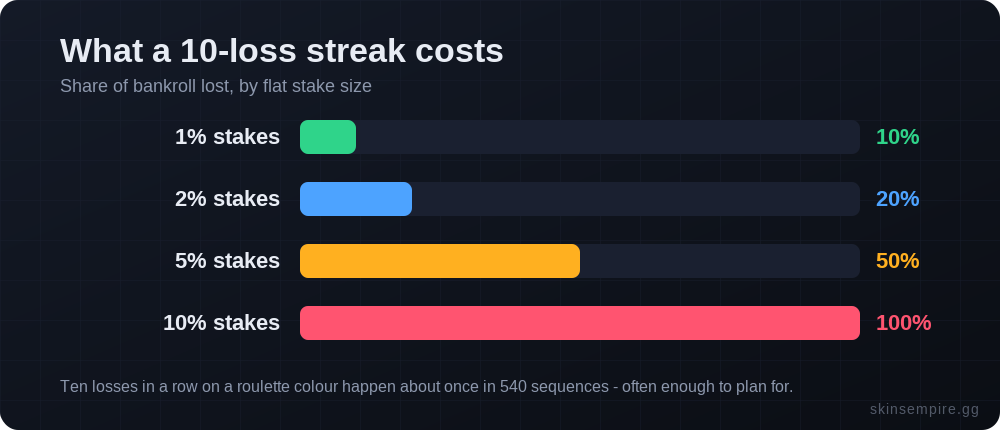
On a roulette colour you lose 53.3% of spins. In a session of 200 spins, a streak of seven losses in a row is more likely than not to appear, and streaks of nine or ten are not rare. At 2% per bet a ten-loss streak costs a fifth of the bankroll; at 10% per bet it ends the session. In crash with a 10x target, you lose roughly 90% of rounds, so runs of 30 or more losses are routine.
Case battles need their own budget
A battle is one large bet: case price times number of rounds. A 10-round battle of $2 cases is a $20 stake you will lose about half the time in a 1v1 and three times in four in a four-player lobby. Keep the cost of a single battle to roughly 5% of your bankroll, which usually means fewer rounds or cheaper cases than the lobby default.
Stop limits in both directions
Set a loss limit - the bankroll itself, or half of it for the day - and a win limit, for example a 50% gain, at which you withdraw. The win limit matters because the house edge is charged on every bet you place: the longer you recycle winnings, the more certain it is that the edge collects them. Withdrawing turns a good run into something real.
Systems that do not work
Martingale - doubling after each loss - trades a long run of tiny gains for one ruinous loss; table limits and your bankroll guarantee the progression eventually breaks. "Waiting for a streak" assumes the game remembers past rounds, and it does not. Raising stakes to recover is the pattern most strongly associated with harmful gambling. Flat staking is dull, and it is the only approach that keeps losses proportional to play.
Use the tools sites give you
Auto cash-out in crash, stop-on-loss in auto-bet, deposit limits and cool-off periods all exist so that a decision made calmly beforehand holds in the moment. If you find yourself overriding them, read our responsible gambling page - the help listed there is free and confidential.
What a bankroll is - and what it is not
A bankroll is the amount of money, or the value in skins, that you have set aside purely for gambling. It is separate from your savings, your rent and the skins you actually want to use in game. The whole point of having one is that losing all of it should be acceptable: annoying, perhaps, but not harmful.
Bankroll management does not change the house edge. No method of sizing bets turns a negative-expectation game into a positive one. What it does is control how fast you lose, how large the swings feel and how likely you are to make decisions you regret. Think of it as a way of buying a predictable amount of entertainment, not as a strategy for winning.
Turning the edge into a budget
The most useful number for planning is the expected cost per hour. Multiply your typical bet by the number of bets per hour and by the house edge:
Expected cost per hour = average bet × bets per hour × house edge
| Game | Example bet | Bets per hour | Typical edge | Expected cost per hour |
|---|---|---|---|---|
| Roulette | $2 | 120 | 6.7% | $16.08 |
| Crash | $2 | 150 | 4% | $12.00 |
| Coinflip | $5 | 40 | 5% | $10.00 |
| Case opening | $3 | 100 | 10-30% | $30.00-$90.00 |
| Case battles | $5 | 60 | 10-20% | $30.00-$60.00 |
The edges here are illustrative; check our house edge guide and each site's game pages for actual figures. The lesson is that game speed matters as much as the edge. A small edge on a very fast game can cost more per hour than a larger edge on a slow one.
Once you know your expected cost per hour, you can set a monthly budget that matches how much you want to play. If you want ten hours a month of crash at $2 bets, plan on losing around $120 on average - and expect the actual result to vary widely around that.
Bet sizing rules that hold up
The 1-2% rule
Many experienced players keep each bet at around 1-2% of their current bankroll. With a $200 bankroll, that means bets of $2 to $4. The rule keeps any single loss small and makes it very unlikely that a normal losing streak wipes you out quickly.
Size down after losses
If your bankroll falls, your bet size should fall with it. Keeping the same bet after losing a third of your bankroll means each bet now represents a larger share of what is left.
Never size up to recover
Raising bets to win back losses is the opposite of bankroll management. It increases the speed of loss and the size of swings at exactly the moment you are most likely to be frustrated.
High-variance games need smaller bets
Games where most outcomes lose and a few pay large multiples - high-multiplier crash cash-outs, expensive cases, upgrader attempts at low odds - produce long losing streaks. If you play them, use smaller bets relative to your bankroll.
How long losing streaks really are
Even even-money bets produce longer streaks than intuition suggests. For a bet with about a 48% chance of winning, over 200 bets the longest losing run is commonly around seven or eight in a row, and longer runs are far from unusual. For a bet that wins one time in ten, runs of thirty or more losses happen regularly.
This is why bankroll size relative to bet size matters. If your bankroll covers only ten bets, a perfectly normal streak can end your session in minutes.
Session rules
Set a loss limit
Decide before each session how much you are prepared to lose, for example 20% of your bankroll. When you hit it, stop.
Set a win goal
It feels strange, but a win goal is as useful as a loss limit. If you hit it - say, 30% above where you started - withdraw some of the winnings and end the session. Winnings left on a site tend to be gambled back.
Set a time limit
Fast games make time disappear. A timer is the simplest safeguard.
Do not play tired, angry or after drinking
These are the moments when sizing rules get ignored.
Skins in your bankroll
If you gamble with skins, extra rules help:
- Value skins before depositing. Convert them into a money value using marketplace data and count that against your budget.
- Do not deposit skins you want to keep. It is easy to gamble a favourite knife after a run of losses. Keep sentimental or loadout items out of your gambling inventory.
- Remember the valuation gap. Sites often value skins below marketplace prices. Depositing a $100 skin may give you less than $100 of balance.
- Track withdrawals as money too. A withdrawn skin is only worth what you can sell it for.
Tracking results
Few players keep records, and most overestimate their results. A simple log - date, site, deposit, withdrawal, net result - takes a minute per session and gives you an honest picture. Review it monthly. If the total loss is more than you planned, reduce your budget or take a break.
Systems that do not work
Betting systems promise to beat the house edge by changing bet size according to results. None of them work, because each bet still carries the same edge.
- Martingale - doubling after each loss - produces many small wins and occasional catastrophic losses when a streak runs longer than your bankroll or the table limit.
- Reverse Martingale - doubling after wins - feels better but has the same expected loss.
- Fibonacci, D'Alembert and similar progressions change the shape of results, not the average.
- Pattern-spotting in roulette or crash history fails because results are independent.
Frequently asked questions
How big should my bankroll be?
Big enough to cover many bets at your chosen size, and small enough that losing it all would not affect your life. For most players, that means a monthly amount set from entertainment money.
Is there a safe bet size?
No bet size makes gambling safe, but small bets relative to your bankroll make losses slower and more predictable.
Should I withdraw when I am ahead?
Yes, at least partly. Taking out winnings protects them from being gambled back.
Do bonuses change bankroll planning?
Bonuses with wagering requirements effectively require you to play a set amount. Plan for the expected cost of that play before accepting.
What should I do if I keep breaking my rules?
That is a warning sign. Use deposit limits or self-exclusion, and see our responsible gambling page for free support.
Three example players
To see how bankroll rules work in practice, consider three players, each with $300 a month for gambling.
Player A plays roulette at $2 per bet. That is under 1% of the bankroll per bet. At around 120 spins an hour and an edge of about 6.7%, the expected cost is about $16 per hour. With $300, Player A can expect roughly eighteen hours of play in a month on average, though actual results will swing widely. Losing streaks rarely end a session early because each bet is small.
Player B opens cases at $5 per opening. That is nearly 2% of the bankroll per opening, but the edge on case opening is often 20% or more. At sixty openings an hour, the expected cost is $60 per hour or more. Player B's $300 lasts about five hours on average - and because most openings return little, the bankroll can disappear in a single session.
Player C plays crash, betting $10 and aiming for high multipliers. That is over 3% of the bankroll per bet, with a strategy that wins rarely. Player C will often lose many bets in a row. The expected cost per hour may be similar to Player A's in theory, but the variance means Player C's bankroll is likely to run out quickly in a bad session.
The lesson: the same budget can give very different amounts of play depending on game choice, bet size and strategy. If you want your budget to last, choose lower-edge games, keep bets small relative to your bankroll, and avoid strategies built around rare wins.
Bonuses and bankroll
Welcome bonuses and deposit matches can stretch a bankroll, but they come with conditions:
- Wagering requirements mean you must bet a multiple of the bonus before withdrawing. That play has an expected cost, which you should include in your planning.
- Game restrictions may limit wagering to certain games, often those with higher edges.
- Maximum bet rules can void the bonus if you bet above a limit.
- Time limits may require wagering to be completed within days.
A bonus is worth taking if its value exceeds the expected cost of meeting its conditions, and if the conditions fit the way you were going to play anyway. Do not change your bet size or game choice just to clear a bonus faster.
Rakeback and loyalty rewards
Many sites return a small percentage of wagers as rakeback or loyalty rewards. Rakeback reduces the effective house edge, but it does not remove it. A 10% rakeback on a 5% edge game, for example, reduces the effective edge to about 4.5%. Count rakeback as a small discount on your entertainment, not as income.
When to take a break
Bankroll management also means knowing when not to play. Consider pausing when:
- You have hit your monthly budget.
- You notice yourself breaking your own rules - bigger bets, longer sessions, redepositing.
- Gambling is affecting your mood, sleep, school, work or relationships.
- You are gambling to escape stress or boredom.
A break of a week or a month is a sensible reset. Most sites offer cool-off tools that make a break easier to stick to.
Reading the simulation tables
The two simulations above make the abstract advice concrete. The first shows how long losing streaks get in two hundred bets for different bet types. Even for a near-even bet, a streak of seven or more losses is typical, and much longer streaks happen in a minority of sessions. For high-multiplier bets, streaks of thirty, forty or more are routine.
The second shows what happens to a $100 bankroll over five hundred flat bets at different bet sizes. With bets of 1% of the starting bankroll, very few sessions go broke, even though the bankroll slowly shrinks on average. With bets of 10%, a large share of sessions end with nothing left. The average loss per dollar wagered is the same in every row; what changes is the chance that a normal run of bad luck wipes you out.
Together, they explain the core of bankroll management: small bets do not make you win, but they make your bankroll last long enough for the entertainment you paid for.
Key takeaways
- Set a bankroll you can afford to lose entirely, and keep it separate from everything else.
- Estimate your cost per hour from stake, speed and house edge, and budget for it.
- Keep bets around 1-2% of your bankroll, smaller for high-variance games.
- Use loss limits, win goals and time limits for every session.
- No betting system beats the house edge.
Bankroll management with skins you love
One special case deserves its own advice. Many players hold a skin they genuinely like using - a knife, gloves, a favourite rifle - and at some point consider gambling it. Treat these items as outside your bankroll by default. If you decide to include one, value it at what you could sell it for, count it against your budget like any other deposit, and accept in advance that you may lose it. Players often regret gambling a loved item far more than losing the equivalent amount of money, because a skin carries memories and a sense of identity that cash does not. If the thought of losing it bothers you, that is a good sign it does not belong in your bankroll.
A bankroll plan is only useful if you follow it when it is inconvenient - after a big loss, or after a big win. Write your rules down, keep them where you can see them, and treat breaking them as a signal to stop for the day.
How long losing streaks get in 200 bets
Simulated 2,000 times for each bet type. "Typical" is the median longest losing streak across simulations; "1 in 10 sessions" is the 90th percentile.
| Bet type | Win chance | Typical longest streak | 1 in 10 sessions | Worst seen |
|---|---|---|---|---|
| Even-money bet (about 48% win) | 48% | 7 | 10 | 18 |
| Roulette colour (7 in 15) | 47% | 7 | 10 | 21 |
| Crash cash-out at 2x (about 48%) | 48% | 7 | 10 | 18 |
| Crash cash-out at 5x (about 19%) | 19% | 18 | 27 | 60 |
| Crash cash-out at 10x (about 9.6%) | 10% | 32 | 49 | 92 |
| Upgrader at 25% chance | 25% | 14 | 21 | 43 |
If your bankroll cannot absorb the "1 in 10 sessions" streak at your chosen bet size, your bet is too large for the game. For high-multiplier bets, that usually means bets well under 1% of the bankroll.
Bet size and the chance of going broke
A $100 bankroll, 500 flat bets, 1,000 simulated sessions per row. Bet size is a fixed share of the starting bankroll.
| Game | Bet size | Sessions that went broke | Median bankroll after 500 bets |
|---|---|---|---|
| Roulette colour | 1% | 0% | $66 |
| Roulette colour | 2% | 31% | $32 |
| Roulette colour | 5% | 86% | $0 |
| Roulette colour | 10% | 95% | $0 |
| Crash at 2x | 1% | 0% | $80 |
| Crash at 2x | 2% | 15% | $60 |
| Crash at 2x | 5% | 69% | $0 |
| Crash at 2x | 10% | 87% | $0 |
| Crash at 10x | 1% | 19% | $80 |
| Crash at 10x | 2% | 54% | $0 |
| Crash at 10x | 5% | 83% | $0 |
| Crash at 10x | 10% | 93% | $0 |
The pattern is consistent: larger bets do not change the average loss per dollar wagered, but they sharply raise the chance of losing everything before the session ends. High-multiplier strategies go broke more often at the same bet size, because their losing streaks are longer.
Keep reading
Provably Fair Explained: How to Verify a CS2 Gambling Round
What a "provably fair" badge proves, what it does not, and how to check a roulette or crash round yourself in five steps.
House Edge in CS2 Gambling: Every Game Compared
Roulette keeps 6.67%, cases keep 8-12%, coinflip can cost under 1%. What each game takes from every $100 you wager.
Curaçao, Anjouan or No Licence: What CS2 Gambling Licences Cover
Most CS2 gambling sites hold a Curaçao or Anjouan licence - or none. What each one means when something goes wrong.