Home / Blog / Provably Fair Explained: How to Verify a CS2 Gambling Round
Provably Fair Explained: How to Verify a CS2 Gambling Round
Fairness
Nearly every CS2 gambling site carries a "provably fair" badge. Few players ever click it. That is a pity, because it is the one claim on a gambling site you can test yourself - and because the badge proves less than most people assume.
The idea in one sentence
The site locks in the result before you bet, shows you a fingerprint of it, and reveals the original afterwards so you can confirm the fingerprint matched. The fingerprint is a cryptographic hash: easy to compute from the secret, practically impossible to reverse or fake.
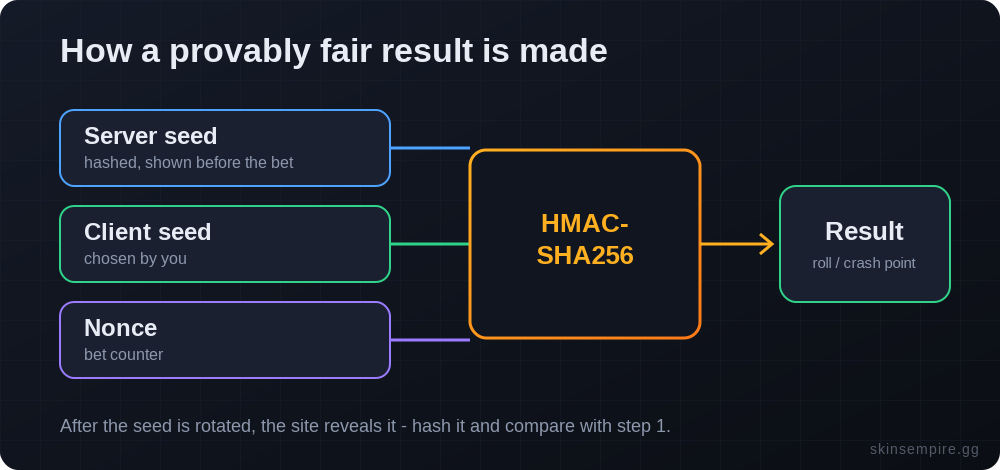
The three ingredients
Server seed. A random string generated by the site. You see only its SHA-256 hash until the seed is retired.
Client seed. A string you control. Because it is mixed into every result, the site cannot pick a server seed that produces bad outcomes for you - it does not know what you will combine it with.
Nonce. A counter that goes up by one with each bet, so the same pair of seeds gives a new result every round.
The result of a bet is computed from all three, typically as HMAC-SHA256(server seed, client seed + nonce), and the first bytes of that output are converted into a roll, a crash point or a case ticket. Shared games such as roulette and crash usually use a variation: a long chain of hashes generated in advance, where each round reveals the previous link, sometimes salted with a public value such as a future Bitcoin block hash that nobody could know when the chain was created.
Checking a round in five steps
- Before playing, open the fairness page and copy the hashed server seed.
- Set your own client seed - any text will do.
- Play a few rounds and note the nonce of one of them.
- Rotate the server seed. The site now reveals the old, unhashed seed.
- Hash the revealed seed with SHA-256 and compare it with the hash from step one; then run seed, client seed and nonce through the site's published formula (or an independent verifier) and compare the result with what you were paid.
If both match, that round was fixed in advance and not altered. If a site cannot show you a hashed seed before you bet, or has no way to rotate it, the badge is decoration.
What provably fair does not prove
It does not remove the house edge: a provably fair roulette wheel still keeps 6.67% of what is staked. It does not cover third-party slots or live tables, which rely on the provider's certification instead. It says nothing about whether the site will process your withdrawal. And for case opening it proves which ticket was drawn, not that the drop table is generous. Fairness of the draw and fairness of the deal are separate questions - our review method scores them separately for that reason.
Which sites make it easy
Among the sites we review, CSGOEmpire documents a separate scheme for roulette, coinflip and battles, and CSGOBig mixes its seed with a number from Random.org. Whichever site you use, run the five steps once. It takes ten minutes and tells you more than any review can.
Hashes in plain language
A cryptographic hash function such as SHA-256 takes any input - a word, a file, a random string - and produces a fixed-length fingerprint. Three properties make it useful for gambling:
- Deterministic. The same input always gives the same fingerprint.
- One-way. You cannot work backwards from the fingerprint to the input.
- Collision-resistant. It is practically impossible to find two inputs with the same fingerprint.
Together these mean a site can publish the fingerprint of a secret before you bet, and later reveal the secret. If the revealed secret produces the same fingerprint, it must be the secret the site committed to - it could not have swapped it for a different one, because no different secret would match.
Commit, play, reveal: the three phases
| Phase | What the site does | What you can do |
|---|---|---|
| Commit | Generates a server seed and publishes its SHA-256 hash | Copy the hash; set your own client seed |
| Play | Combines server seed, client seed and nonce into each result | Note the nonce and result of any bet |
| Reveal | Retires the server seed and shows it in full | Hash it and recompute results |
The order is what makes the system work. The site cannot change the server seed after committing to it, and it cannot choose a server seed that produces bad results for you because it does not know your client seed in advance - or, in shared games, because an outside value is mixed in after the commitment.
From hash output to a game result
The combined hash is a long string of hexadecimal characters. Sites convert part of it into a number, and that number into the result. Typical conversions:
- Dice: take the first few bytes, turn them into a number between 0 and 1, scale to 0-100.
- Roulette: take a number and reduce it modulo the number of slots, giving a position on the wheel.
- Crash: apply a formula that maps the number onto a multiplier, with a small share of outcomes set to 1.00x to produce the house edge.
- Cases: map the number onto ticket ranges, one range per item, sized to each item's percentage.
- Coinflip: even or odd, or above or below a midpoint.
Each site publishes its exact conversion on its fairness page. A verifier - the site's own or an independent one - repeats the calculation so you can check it.
Hash chains for shared games
Single-player games use per-player seeds. Shared games such as crash and roulette cannot, because everyone sees the same result. They use a hash chain: the site generates a long sequence where each value is the hash of the next. It publishes the final value in advance, then plays the chain backwards, revealing one value per round. Because each revealed value hashes to the one before it, nobody - including the site - can change future rounds without breaking the chain. Many sites also mix in a public value that did not exist when the chain was created, such as the hash of a future Bitcoin block, so the site could not have chosen a chain with convenient results.
Common implementation weaknesses
Provably fair is a design pattern, not a guarantee. Implementations can be weak in ways that defeat the purpose:
| Weakness | Why it matters | How to spot it |
|---|---|---|
| No client seed, no external value | The site picks all inputs and could select favourable seeds | Fairness page lists only a server seed |
| Server seed never revealed | Commitments cannot be checked | No rotation button, no revealed seeds in history |
| Hash shown after betting | Commitment is meaningless | Hash appears only with the result |
| Conversion formula unpublished | Results cannot be recomputed | Fairness page gives no formula or verifier |
| Verifier hosted only by the site | You trust the site to check itself | No independent way to run the calculation |
A strong implementation lets you set your own client seed, shows the hashed server seed before play, reveals it on request, documents the formula and works with independent verifiers.
A five-minute check on any site
- Open the fairness page and read which inputs are used.
- Set a custom client seed - any phrase you choose.
- Place three small bets and note their nonces and results.
- Rotate the server seed and copy the revealed value.
- Run all three bets through a verifier and confirm the results match.
If the site cannot support steps 2, 4 or 5, its "provably fair" label is not doing much.
Worked example: verifying a dice roll by hand
Here is the logic of a typical dice verification, step by step. The exact formula varies between sites; the structure does not.
- Inputs. Server seed (revealed): a 64-character string. Client seed: the phrase you set, say "mylucky7". Nonce: 42, because it was your 43rd bet with this seed pair.
- Combine. Compute HMAC-SHA256 with the server seed as the key and "mylucky7:42" as the message. The output is 64 hexadecimal characters.
- Take bytes. Read the first 8 characters, for example "a3f1c09b", as a hexadecimal number. That is 2,750,529,691.
- Scale. Divide by 4,294,967,296 (16 to the power of 8) to get a number between 0 and 1: about 0.6404.
- Map to the game. Multiply by 100 for a dice roll of 64.04.
- Compare. If the game showed 64.04, the result matches.
Separately, hash the revealed server seed with SHA-256 and compare it with the hash shown before you started betting. If both checks pass, the roll was fixed by inputs committed before you placed the bet.
What provably fair means for cases and battles
Case openings use the same machinery with a different final step: the number is mapped onto ticket ranges. If a case has an item with a 0.5% chance, that item owns half a percent of the range - for example tickets 99,501 to 100,000 out of 100,000. Verification confirms that your ticket fell in the range of the item you received. It does not confirm that the item's listed value is fair, or that the case's price is reasonable. That is why the cost of a case has to be judged separately, by reading its drop table, as our case opening guide explains.
For battles, each seat's openings are derived from seeds in the same way. Some sites publish a seed per seat; others publish one battle-level seed from which each seat's results are derived. Either works, provided the commitment is shown before the battle starts.
Provably fair versus certified RNG
Third-party slots and live tables on crypto casinos usually are not provably fair in this sense. Their randomness is certified by testing laboratories, and their return-to-player figures are set and published by the game provider. That is a different kind of assurance: you rely on the provider and the lab instead of checking each result yourself. Neither system is "better" in every way - certification covers the whole game design, while provably fair covers individual results - but it is worth knowing which one applies to the game you are playing.
| Provably fair | Certified RNG | |
|---|---|---|
| Who checks | You, after each round | A testing laboratory, periodically |
| What is checked | That each result followed from committed inputs | That the generator and game behave as specified |
| Typical games | House originals: dice, crash, roulette, cases | Third-party slots and live tables |
| Proves the edge is low? | No | RTP is published by the provider |
Questions readers ask about provably fair
Can a site still cheat with provably fair games? It can set an expensive game - a high edge or an unfair case - but it cannot change individual results without breaking the commitment you can check. It could also refuse to pay; fairness of results says nothing about payouts.
Do I need to verify every bet? No. Verifying a sample on each new site, and any result you are unhappy with, is enough to keep a site honest.
Is changing my client seed lucky? No. It ensures the site cannot predict your results; it does not improve your odds.
What if the verifier says a result does not match? Take screenshots of the inputs and outputs and contact support. A genuine mismatch on a properly implemented system is extremely rare and would be serious.
Can I verify a game after a seed has been in use for months? Yes, once the seed is revealed - but some sites only reveal on rotation, so rotate occasionally if you want to check past results.
Glossary
- Server seed - the site's secret input, committed by hash and revealed later.
- Client seed - your input, mixed into results so the site cannot pre-select outcomes.
- Nonce - a counter that increases with each bet.
- Hash - a one-way fingerprint of some data.
- HMAC - a keyed hash that combines two inputs securely.
- Hash chain - a pre-generated sequence used for shared games.
- Seed rotation - retiring the current server seed and revealing it.
- Verifier - a tool that recomputes results from revealed inputs.
A short history of provably fair gambling
The idea grew out of early Bitcoin dice sites around 2012-2013. Players could not inspect the operators' servers, and the operators were often anonymous, so the sites needed a way to prove they were not changing results. Publishing a hash of the server seed before each bet and revealing the seed afterwards solved the problem with tools that anyone could run. When skin gambling exploded in 2015-2016, operators borrowed the same approach for roulette, jackpot and coinflip, and it became a basic expectation of the audience. Today, a fairness page with seeds and a verifier is standard on reputable skin sites and on the "originals" sections of crypto casinos - and its absence is a warning sign.
How provably fair fits into choosing a site
A working fairness system is a minimum, not a recommendation. It tells you the site is not secretly rigging individual results. It does not tell you how expensive the games are, how items are valued, whether withdrawals are paid promptly, or who runs the business. That is why our review method treats fairness as one criterion among six. A site can score well on fairness and still rank low because its licence cannot be verified, as several in our list do.
| You want to know... | Provably fair tells you | Look elsewhere for |
|---|---|---|
| Was this round tampered with? | Yes | - |
| How much does this game cost me? | No | Published edge, payout rules, drop tables |
| Will the site pay my withdrawal? | No | Licence, track record, public reviews |
| Are item values fair? | No | Marketplace price comparison |
Key takeaways
- A hash commitment before the bet plus a reveal afterwards proves the result was fixed in advance.
- Your client seed or an external random value stops the site from choosing convenient seeds.
- Verify a few bets on any new site; it takes minutes.
- Provably fair says nothing about the house edge, item values or payouts.
- Third-party slots rely on certified RNG instead; check their published RTP.
If you want to put this into practice, our game guides for crash, roulette and coinflip each include a short verification walk-through for that game.
Provably fair on the sites we review
| Site | What we found on its fairness system |
|---|---|
| CSGOEmpire | Round hashes published before betting for roulette; documented schemes for coinflip and battles |
| CSGORoll | Seeds and verification for cases, battles and house games |
| CSGO500 | Public verifier for the originals; third-party slots use certified RNG |
| Gamdom | Seeds for crash, roulette, dice and other originals |
| BC.Game | Fairness panel on each BC Original |
| Rainbet | Provably fair originals with adjustable risk |
| CSGOLuck | Seed-based fairness across its house games |
| CSGOBig | Server seed combined with a Random.org value |
| CSGOFast | Verification available for most, not all, modes |
Implementations change, so treat the table as a starting point and run the five-minute check yourself on the site you use.
When a result looks wrong
If a round's outcome surprises you, verification is quick and decisive. Gather the server seed hash shown before the bet, the revealed server seed, your client seed and the nonce. Run them through the site's verifier and, ideally, an independent one. If the numbers match, the result was fair and the surprise was just variance. If they do not, contact support with screenshots of every input and output; on a licensed site you can also take a documented mismatch to the regulator. In practice, almost every "rigged" complaint dissolves at the verification step - which is exactly why it is worth knowing how to do it.
A final checklist
Before you rely on a site's provably fair claim, make sure you can answer yes to each of these:
- The site shows a hashed server seed before you play.
- You can set or at least see your own client seed.
- A nonce or round number is shown for each bet.
- The site reveals the unhashed server seed when you rotate it.
- The site publishes the exact formula or code that turns seeds into results.
- An independent verifier - your own script or a third-party tool - produces the same results.
If any of these is missing, the system may still be honest, but you cannot prove it - and the whole point of provably fair is that you do not have to take anyone's word for it.
Provably fair is a strong guarantee about one thing - that a result was not changed after you bet - and no guarantee at all about the house edge, the site's solvency or its willingness to pay. Use it alongside the other checks in our reviews, not instead of them.
If you only remember one thing from this guide, make it this: verify a few of your own results, at least once, on any site you use regularly.
It takes a few minutes, it costs nothing, and it is the only way to know for sure that the system works as advertised.
Keep reading
House Edge in CS2 Gambling: Every Game Compared
Roulette keeps 6.67%, cases keep 8-12%, coinflip can cost under 1%. What each game takes from every $100 you wager.
Curaçao, Anjouan or No Licence: What CS2 Gambling Licences Cover
Most CS2 gambling sites hold a Curaçao or Anjouan licence - or none. What each one means when something goes wrong.
Skin Deposits vs Crypto Deposits: What Each Really Costs
Skins feel free to deposit and crypto feels complicated. In practice the hidden spread on skins is usually the bigger cost.