Home / Blog / Skin Deposits vs Crypto Deposits: What Each Really Costs
Skin Deposits vs Crypto Deposits: What Each Really Costs
Payments
There are two main ways to fund an account on a CS2 gambling site: send skins from your Steam inventory, or send cryptocurrency. They suit different people, and they cost different amounts in ways that are not obvious at the cashier.
Depositing skins
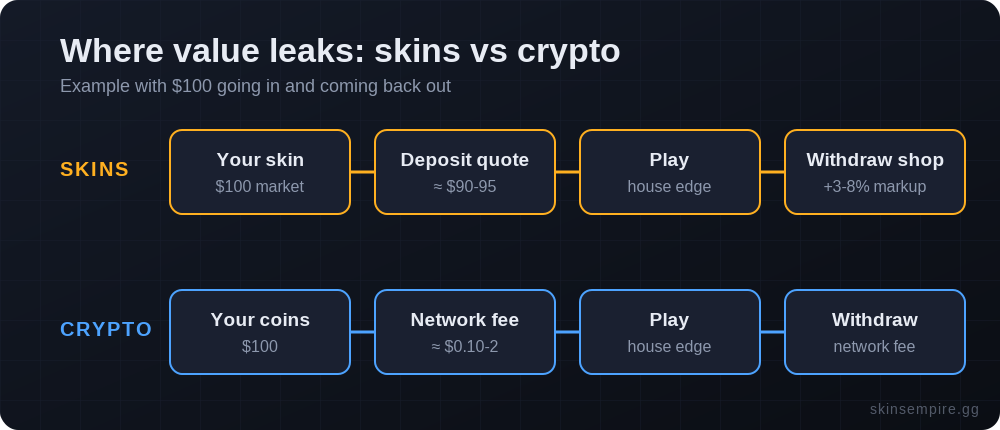
You pick items, the site quotes a value, and a trade moves them - to a site bot or, on peer-to-peer platforms, to another player who is withdrawing. The cost is the spread: the difference between the quote and what the skin would sell for on a marketplace. On bot-based sites the quote is often 5-15% below market for common items and worse for rare ones, because the site has to resell them. Peer-to-peer systems such as the one on CSGOEmpire keep quotes closer to market, since the buyer is a player who wants that exact item.
Check the quote before you accept. Look the item up on our price list or with the price checker; if the offer is more than about ten percent under the lowest listing, selling the skin on a marketplace and depositing the proceeds will leave you with more.
Depositing crypto
You send coins to an address and the balance appears after a set number of network confirmations. Costs are visible: the network fee, plus an exchange fee if you had to buy the coins. Stablecoins on low-fee networks and coins such as Litecoin typically cost cents to send. There is no valuation spread - a dollar of USDT is credited as a dollar.
The trade-offs are practical. You need a wallet or exchange account, transactions are irreversible, and sending on the wrong network can lose the funds. Sites may also ask for identity documents once crypto volumes pass a threshold.
Withdrawals mirror deposits
Crypto withdrawals are normally processed within minutes to an hour and arrive as an exact amount. Skin withdrawals mean choosing items from a shop or marketplace priced by the site, usually a few percent above outside markets, so the spread is paid a second time. After the trade, Steam's trade protection can prevent the item from being moved again for several days.
Side by side
| Skins | Crypto | |
|---|---|---|
| Main cost | Valuation spread, both directions | Network / exchange fees |
| Speed in | Minutes (trade offer) | Minutes (confirmations) |
| Speed out | Minutes to hours; Steam holds may apply | Minutes to an hour |
| What you need | Steam account with tradable items | Wallet or exchange account |
| Best for | Small amounts, players who want skins back | Larger amounts, cashing out to money |
Which to choose
If you already hold skins and want to play small, depositing them is simple and the spread on a few dollars is negligible. For anything larger, or if your goal is to end up with money rather than items, crypto is usually cheaper end to end. Whatever you use, deposit only what you have already decided you can lose.
The real difference: how value is measured
The biggest difference between depositing skins and depositing cryptocurrency is not speed or fees - it is how the value of your deposit is decided.
With crypto, the value is clear: you send a known amount of a coin, and the site credits you at the current exchange rate, sometimes minus a small spread. With skins, the site decides what your items are worth, using its own pricing. That price is usually below what you would get selling on a marketplace, and it rarely takes into account float, pattern or stickers.
So the question to ask before depositing skins is: how much balance will I actually receive, and how does that compare with what I could sell the skins for? The deposit screen on most sites shows a value for each item before you confirm. Compare it with marketplace prices.
A worked comparison
Imagine you have skins worth $100 at their lowest marketplace listing.
| Route | What you get | Notes |
|---|---|---|
| Deposit skins directly | Often somewhat less than $100 in balance | Site's valuation applies |
| Sell on a marketplace, then deposit crypto | $100 minus selling fees, minus crypto conversion costs | Takes longer, more steps |
| Sell on a marketplace quickly | Often below the lowest listing | Speed costs money |
Which route is better depends on the site's valuation of your specific skins. For liquid, popular skins, gambling sites often value close to market. For unusual or rare items, the gap can be larger.
Speed
- Skin deposits depend on Steam trades. Under normal conditions, a deposit is credited once you accept the trade offer - often within minutes. During Steam outages, it can be delayed.
- Crypto deposits depend on network confirmations. Fast networks credit deposits in seconds to minutes; congested networks can take longer.
- Card or bank deposits, where offered, are usually instant but may be more restricted and carry higher fees.
Withdrawals
Withdrawals mirror deposits, but with extra considerations:
- Skin withdrawals depend on the site having the items you want in stock, and on Steam trade conditions. Items you withdraw may be subject to Steam's trade protection rules. If a site uses a peer-to-peer system, you receive the items directly from another user.
- Crypto withdrawals are usually faster and more predictable once approved, but may be subject to minimums, network fees and verification checks.
- Verification: many sites require identity verification for larger withdrawals, especially crypto ones. Do this before you need to withdraw to avoid delays.
Risks
Skin-specific risks
- Steam trade restrictions can lock items temporarily.
- Valuation risk: the site's price may change between deposit and withdrawal.
- Scams: fake trade offers and impersonation bots target skin depositors. Always confirm trade offers in the Steam mobile app and check the details.
- Account risk: if your Steam account is compromised, your skins are at risk.
Crypto-specific risks
- Volatility: if you hold crypto between deposit and withdrawal, its value can change significantly.
- Wrong network or address: sending crypto to the wrong network or address can mean losing it permanently.
- Fees: network fees vary and can be significant for small amounts on some networks.
- Regulatory and tax considerations differ by country.
Which should you use?
- Use skins if you already have skins you are happy to gamble, the site values them fairly, and you want the convenience of trading directly from your inventory.
- Use crypto if you want precise control over the amount you deposit, faster withdrawals and less dependence on Steam.
- Avoid depositing valuable or sentimental skins, especially rare patterns or low floats that the site will not value properly.
Whichever method you use, count the deposit against your gambling budget in money terms.
Tips for skin deposits
- Compare deposit values across sites; they can differ noticeably for the same item.
- Deposit liquid, popular items that are valued consistently.
- Avoid depositing items with valuable stickers; stickers are usually ignored.
- Check for deposit bonuses, but read the wagering terms.
Tips for crypto deposits
- Double-check the network and address before sending.
- Use stablecoins if you want to avoid price swings between deposit and withdrawal, where offered.
- Keep transaction IDs in case you need support.
- Be aware of minimum deposit and withdrawal amounts.
Frequently asked questions
Are skin deposits cheaper than crypto?
Not necessarily. There are no network fees for skins, but the site's valuation can cost you more than crypto fees.
Why did my skin deposit give me less than its market price?
Sites value skins with their own pricing, usually below marketplace prices, to manage risk and liquidity.
Can I withdraw crypto if I deposited skins?
Many sites allow it, but some have rules or minimum wagering requirements before you can withdraw in a different form.
Which is safer?
Both can be safe with care. Skin deposits carry Steam-related risks; crypto deposits carry address and volatility risks.
Do bonuses apply to both?
It depends on the site. Some bonuses apply only to certain deposit methods; check the terms.
How sites price skin deposits
Every site has its own method, but most follow a similar pattern. They start with a reference price from one or more marketplaces, then apply adjustments:
- A general discount to protect the site against price movements and the cost of reselling items.
- Liquidity adjustments, valuing slow-selling or unusual items lower than popular ones.
- Exclusions for items the site will not accept at all - often very cheap items, some stickers and graffiti, souvenir packages, or items it considers too hard to price.
- Caps on very expensive items, where the site may set a maximum value or require manual review.
Some sites show the reference price and the deposit value side by side; others show only the deposit value. If a site does not show its reference, compare the deposit value with the lowest listing and recent sales on a marketplace. A gap of a few percent is normal. A large gap means the site is pricing your items cautiously, and another site or a different deposit method may give better value.
Peer-to-peer versus bot deposits
Skin deposits work in one of two ways:
- Bot deposits: you trade your skins to a bot account owned by the site. The site holds the items and credits your balance.
- Peer-to-peer (P2P) deposits: you list your skins on the site, another user buys them with their balance, and you send the items directly to that user. Your balance is credited once the trade is confirmed.
P2P systems have become more common, partly because they reduce the number of skins a site has to hold. For depositors, P2P usually means a short wait while a buyer is found and a requirement to send the trade within a time limit. It also means the price can sometimes be adjusted by the depositor, within limits, to attract a buyer faster.
Trade protection and reversals
Steam has added protections that allow some trades to be reversed within a limited period. Sites handle this in different ways - for example, by delaying the credit of a deposit, or by placing a hold on items until the protection period ends. Check the site's deposit page or help section to understand how long you may wait before your balance is usable or your withdrawn items are fully yours. If a deposit takes longer than the site says it should, contact support with the trade offer details rather than sending the items again.
Crypto deposit checklist
Before sending crypto to a gambling site, run through this list:
- Coin and network match. The deposit address shown is for one specific coin on one specific network. Sending a token on the wrong network can mean losing it.
- Memo or tag. Some coins require a memo or destination tag. Missing it can delay or lose the deposit.
- Minimum deposit. Amounts below the minimum may not be credited.
- Address copied correctly. Use copy and paste and check the first and last characters.
- Fees understood. Your wallet or exchange may charge a withdrawal fee on top of the network fee.
- Transaction ID saved. If anything goes wrong, support will ask for it.
Taxes and records
Tax rules for gambling and cryptocurrency differ widely between countries, and skins add another layer of complexity because they can be treated as property in some places. We cannot give tax advice, but keeping good records is always sensible: dates, amounts, values in your local currency at the time, and the site used. Records also help if you ever need to dispute a deposit or withdrawal with a site.
Summary
| Factor | Skins | Crypto |
|---|---|---|
| Value certainty | Site decides | Exchange rate decides |
| Typical speed | Minutes, Steam-dependent | Seconds to minutes, network-dependent |
| Main hidden cost | Valuation gap | Network and exchange fees |
| Main risk | Scams and trade issues | Wrong address or network, volatility |
| Best for | Players with skins they are happy to gamble | Players who want precise amounts and fast withdrawals |
More questions about deposits
Is there a minimum skin value for deposits?
Most sites set one, often well under a dollar, to avoid processing trades for near-worthless items. Items below the minimum are usually greyed out on the deposit screen.
Can I cancel a skin deposit?
Before you accept the trade offer, yes - simply decline it. After the trade is complete, the deposit is final, although Steam's trade protection may briefly allow reversals in some cases. Do not try to reverse a deposit after you have used the balance; sites treat that as fraud.
Why are some of my skins not accepted?
Sites exclude items they cannot price reliably or resell easily, items under the minimum value, and sometimes entire categories such as graffiti or certain souvenir items. Items on trade hold cannot be deposited until the hold ends.
Should I convert crypto to a stablecoin first?
If you want your balance to stay at a fixed dollar value while you play, using a stablecoin where the site supports it avoids exposure to price swings in more volatile coins.
What happens if I send crypto below the minimum?
It may not be credited automatically. Contact support with the transaction ID; some sites can credit it manually, others cannot.
A simple rule of thumb
If you already hold skins that you are happy to gamble and the site's valuation is within a few percent of the marketplace price, depositing them directly is usually the most convenient option. If the valuation gap is large, or if your skins have features the site ignores - a low float, a rare pattern, valuable stickers - sell them on a marketplace first and deposit the proceeds in another form. And if you are starting from cash rather than skins, there is no need to buy skins just to deposit them: the fees of buying and the valuation gap of depositing both work against you. Whatever you choose, record the value of each deposit in money so your gambling budget stays honest.
Neither method is better in every case. What matters is that you know the real value of what you are depositing, understand how long withdrawals will take, and keep the total within the budget you set for gambling before you started.
The most liquid skins to deposit
Skins worth $1 or more with the most copies listed. Liquid skins are valued more consistently by gambling sites and are easier to sell if you change your mind.
| Item | Lowest listing | Listed | Sold 30d | 30-day median |
|---|---|---|---|---|
| M4A1-S | Solitude (Field-Tested) | $1.18 | 2263 | 167 | $1.31 |
| M4A1-S | Black Lotus (Field-Tested) | $2.99 | 1235 | 504 | $3.35 |
| FAMAS | Rapid Eye Movement (Field-Tested) | $3.88 | 1101 | 167 | $4.81 |
| UMP-45 | K.O. Factory (Field-Tested) | $3.31 | 1032 | 142 | $3.71 |
| Dual Berettas | Melondrama (Field-Tested) | $3.64 | 1031 | 153 | $4.86 |
| Zeus x27 | Olympus (Field-Tested) | $2.32 | 986 | 155 | $2.54 |
| Glock-18 | Vogue (Field-Tested) | $3.03 | 940 | 209 | $3.13 |
| MP7 | Abyssal Apparition (Field-Tested) | $3.97 | 894 | 171 | $4.87 |
| AK-47 | Searing Rage (Field-Tested) | $3.75 | 861 | 208 | $3.82 |
| M4A4 | Tooth Fairy (Field-Tested) | $2.53 | 843 | 177 | $3.07 |
| P250 | Visions (Field-Tested) | $2.70 | 832 | 116 | $2.94 |
| AK-47 | Slate (Field-Tested) | $3.24 | 763 | 234 | $3.68 |
| XM1014 | Entombed (Field-Tested) | $2.80 | 727 | 68 | $2.89 |
| Desert Eagle | Tilted (Factory New) | $1.05 | 715 | 150 | $1.14 |
| AK-47 | Ice Coaled (Field-Tested) | $3.40 | 695 | 221 | $3.71 |
| UMP-45 | Wild Child (Field-Tested) | $2.44 | 625 | 107 | $2.65 |
| M4A1-S | Black Lotus (Minimal Wear) | $5.23 | 623 | 399 | $5.65 |
| Sawed-Off | Kiss♥Love (Field-Tested) | $2.89 | 603 | 73 | $2.98 |
| AWP | Duality (Field-Tested) | $2.32 | 589 | 212 | $2.62 |
| AK-47 | Elite Build (Field-Tested) | $1.52 | 558 | 73 | $1.60 |
| P2000 | Wicked Sick (Field-Tested) | $2.43 | 542 | 98 | $2.66 |
| AK-47 | Redline (Field-Tested) | $21.21 | 542 | 285 | $24.80 |
| MP9 | Starlight Protector (Field-Tested) | $41.02 | 531 | 141 | $49.57 |
| MP7 | Fade (Factory New) | $7.16 | 520 | 115 | $9.50 |
| M4A1-S | Solitude (Minimal Wear) | $2.50 | 492 | 172 | $3.49 |
| Glock-18 | Candy Apple (Factory New) | $1.42 | 470 | 338 | $1.44 |
| M4A4 | Turbine (Field-Tested) | $1.03 | 465 | 38 | $1.00 |
| AWP | Atheris (Field-Tested) | $3.49 | 448 | 246 | $3.81 |
| Dual Berettas | Melondrama (Well-Worn) | $3.64 | 445 | 71 | $4.78 |
| MAG-7 | Carbon Fiber (Factory New) | $1.77 | 444 | 19 | $1.92 |
| AK-47 | Slate (Minimal Wear) | $5.63 | 438 | 300 | $6.08 |
| Five-SeveN | Heat Treated (Field-Tested) | $1.79 | 427 | 47 | $1.96 |
| FAMAS | Rapid Eye Movement (Well-Worn) | $3.83 | 418 | 88 | $4.66 |
| Glock-18 | Shinobu (Field-Tested) | $3.53 | 415 | 331 | $3.96 |
| USP-S | Jawbreaker (Field-Tested) | $2.74 | 414 | 296 | $3.02 |
| AK-47 | Elite Build (Well-Worn) | $1.29 | 413 | 45 | $1.20 |
| AK-47 | Ice Coaled (Minimal Wear) | $5.99 | 403 | 152 | $6.54 |
| Desert Eagle | Printstream (Field-Tested) | $26.69 | 386 | 548 | $30.19 |
| Desert Eagle | Heat Treated (Minimal Wear) | $2.01 | 376 | 167 | $2.41 |
| AK-47 | Nightwish (Field-Tested) | $40.88 | 366 | 116 | $50.18 |
| XM1014 | XOXO (Field-Tested) | $2.77 | 363 | 55 | $2.88 |
| XM1014 | Entombed (Minimal Wear) | $3.06 | 362 | 62 | $3.26 |
| R8 Revolver | Blaze (Factory New) | $2.23 | 362 | 225 | $1.90 |
| MAC-10 | Disco Tech (Field-Tested) | $4.50 | 361 | 94 | $4.75 |
| AWP | Mortis (Field-Tested) | $2.75 | 360 | 78 | $2.94 |
| Desert Eagle | Mulberry (Minimal Wear) | $5.11 | 358 | 232 | $6.58 |
| AK-47 | Legion of Anubis (Field-Tested) | $24.28 | 350 | 84 | $27.72 |
| MP7 | Abyssal Apparition (Well-Worn) | $3.82 | 342 | 66 | $4.77 |
| Glock-18 | Water Elemental (Field-Tested) | $15.46 | 340 | 94 | $16.08 |
| Desert Eagle | Serpent Strike (Factory New) | $1.22 | 340 | 156 | $1.39 |
Keep reading
Provably Fair Explained: How to Verify a CS2 Gambling Round
What a "provably fair" badge proves, what it does not, and how to check a roulette or crash round yourself in five steps.
House Edge in CS2 Gambling: Every Game Compared
Roulette keeps 6.67%, cases keep 8-12%, coinflip can cost under 1%. What each game takes from every $100 you wager.
Curaçao, Anjouan or No Licence: What CS2 Gambling Licences Cover
Most CS2 gambling sites hold a Curaçao or Anjouan licence - or none. What each one means when something goes wrong.