Home / Blog / Curaçao, Anjouan or No Licence: What CS2 Gambling Licences Cover
Curaçao, Anjouan or No Licence: What CS2 Gambling Licences Cover
Licensing
Scroll to the bottom of any CS2 gambling site and you will find a line of small print naming a company and, usually, a licence. That line is the best quick indicator of how much protection you have. Here is how to read it.
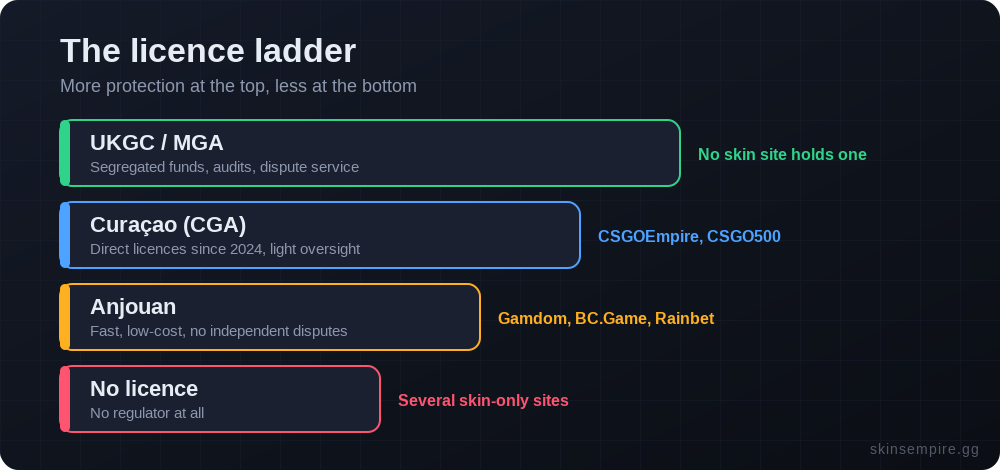
The ladder of regulators
Strict national regulators - the UK Gambling Commission, the Malta Gaming Authority and similar bodies - require segregated player funds, audited games, strong identity checks and access to an independent dispute service. No skin gambling site holds one of these licences, largely because betting with tradable game items does not fit their rules.
Curaçao has licensed online gambling since the 1990s and is the traditional home of crypto and skin casinos. For years it worked through a handful of "master" licence holders who sold sub-licences with little oversight. A new law, in force since 2024, moved licensing to the Curaçao Gaming Authority and introduced direct licences with numbers in the format OGL/2024/..., along with stricter requirements. It is still a light regime by European standards, but a current, verifiable Curaçao licence is the best most skin sites offer.
Anjouan, an island in the Union of Comoros, became popular as Curaçao tightened up. Licences are quick and inexpensive to obtain. Reviewers consistently note the same gap: no independent body to take a complaint to. Several large brands - Gamdom, BC.Game and Rainbet among them - now operate under Anjouan licences.
No licence. A number of skin-only sites run without one. Some have paid players reliably for years; none gives you anywhere to turn if they stop.
How to verify a licence in two minutes
- Find the operating company name and licence number in the footer or terms.
- Open the regulator's public register (the Curaçao Gaming Authority and Anjouan's licensing body both publish one) and search for the number or company.
- Check that the domain you are on is listed for that licence - licences cover named domains, and clone sites borrow other companies' numbers.
- If the footer shows only a logo and no number, treat the site as unlicensed.
What a licence does and does not change
Even a light licence means a registered company exists, someone passed a basic fit-and-proper check, and there is a regulator the operator would rather not upset. It does not guarantee payouts, it does not make gambling legal where you live, and it does not replace the evidence of a long operating record. In our scoring, licence and operator transparency together carry 25% of the total - the largest single weight - but a ten-year history under a known owner can count for as much as the paper.
Practical rules
On an unlicensed or unverifiable site, keep your balance small and withdraw winnings the same day. Complete any identity verification before you deposit, not when you are trying to cash out. And never sign up from a country the terms exclude: a restricted-region clause is the easiest reason a site has to void a balance.
Why licensing is complicated for skin gambling
Most gambling regulators were designed around casinos and sportsbooks that take deposits in money. Skin gambling does not fit neatly into that model. Players deposit virtual items that have a real-money value on third-party marketplaces, and many sites mix skins, cryptocurrency and card payments. Some regulators treat skins as money's worth and therefore as gambling stakes; others have never formally addressed them. The result is that the CS2 gambling market runs under a patchwork of licences, ranging from tightly regulated to essentially none.
For players, that means a licence badge on a site's footer can mean very different things. This guide explains the main jurisdictions you are likely to see, what each one actually requires, and how to judge the protection a licence gives you.
The main jurisdictions you will see
Curaçao
Curaçao has long been the most common licence among crypto and skin gambling sites. For many years, licences were issued through a small number of master licence holders, who could grant sub-licences to operators. That system was criticised for weak oversight and slow complaint handling. Curaçao has been reforming its framework, moving towards direct licences issued by a national gaming authority with stricter requirements on ownership checks, anti-money-laundering procedures and player complaints.
In practice, a Curaçao licence today can mean anything from an older sub-licence to a newer direct licence. When you see Curaçao, check the licence number and look it up on the regulator's public register or validator.
Anjouan
Anjouan, one of the islands of the Comoros, has become a popular licensing jurisdiction for online gambling operators, including some crypto and skin sites. Its licences are relatively quick and inexpensive to obtain. Player protection and dispute resolution are generally considered weaker than in established European regulators. An Anjouan licence shows that an operator went through some formal process, but it should not be read as a strong guarantee.
Malta
The Malta Gaming Authority is one of the most established gambling regulators in Europe. Its licences come with substantial requirements: capital, audits, responsible gambling tools, segregation of player funds and a formal complaints process. Few skin-focused sites hold an MGA licence, partly because of the cost and partly because of uncertainty over how skins fit into its rules.
United Kingdom
The UK Gambling Commission is among the strictest regulators in the world. It has taken a firm position that in-game items with real-world value used as stakes are covered by gambling law, and it has taken action against unlicensed skin gambling aimed at UK players. Sites that do not hold a UK licence generally block UK players.
Other jurisdictions
You may also see licences from places such as the Isle of Man, Gibraltar, Kahnawake or Costa Rica. Isle of Man and Gibraltar are strong regulators with high standards. Costa Rica does not issue gambling licences as such; sites citing Costa Rica are usually registered companies rather than licensed operators. Some sites state no licence at all.
What a licence can and cannot do for you
| Question | Strong regulator | Lighter regulator | No licence |
|---|---|---|---|
| Is the operator a known legal entity? | Yes, checked | Usually | Not necessarily |
| Are games tested or audited? | Typically required | Sometimes | Only if the site chooses |
| Are responsible gambling tools required? | Yes | Often limited | Not required |
| Is there an independent complaints route? | Yes | Sometimes, slow | No |
| Are player funds protected if the site fails? | Often, to some degree | Rarely | No |
A licence is not a guarantee that you will win, that a site will never delay a withdrawal, or that you will get your money back if something goes wrong. It is one piece of evidence about how seriously an operator takes its obligations.
How to check a licence properly
- Find the licence details. Reputable sites show the licence number, the regulator and the licensee's company name, usually in the footer or terms.
- Check the regulator's register. Most regulators publish a list of licensees. Search for the company name or licence number.
- Match the company. The company named on the licence should match the company named in the site's terms and conditions.
- Check the domain. Some licences list the domains they cover. Make sure the site you are using is one of them.
- Look for a seal that links out. Many regulators provide a validation seal that links to a live verification page. A static image with no link proves nothing.
- Search for complaints. A licence plus a pattern of unresolved withdrawal complaints is a warning sign.
If any of these steps fail - no licence number, a company that does not match, a seal that leads nowhere - treat the licence claim as unverified.
Licences and skin deposits
Even where a site holds a licence, the licence may not specifically cover skin deposits. Some regulators license the operator for real-money gambling and do not address virtual items. In disputes involving skins, regulators may be less able or willing to help, particularly if the value of the items is disputed. Keep records of skin deposits - screenshots of trade offers and site balances - so you can show what you deposited and when.
Location restrictions
Licences come with restrictions on where an operator can accept players. Sites commonly exclude countries such as the United Kingdom and the United States, or specific US states, along with others where their licence does not apply. Using a VPN to get around these restrictions usually breaks the site's terms, and many sites will refuse withdrawals - or close accounts - if they discover it. If a site is not available in your country, that is a reason to look elsewhere, not to hide your location.
Valve's position
Valve does not license or endorse any gambling site. Its terms prohibit using Steam accounts and trading for commercial gambling purposes, and in the past it has sent cease-and-desist letters to skin gambling sites and restricted trading by bots it associates with gambling. Valve's actions can affect sites quickly - for example, by making it harder for them to move skins - so a site's long-term reliability also depends on how it handles such risks.
How we use licensing in our reviews
On SkinsEmpire, licensing is part of the trust score in every review. We:
- Report the licence a site claims, the regulator and the operating company.
- Check that information against public registers where possible and say when we could not verify it.
- Give more weight to regulators with stronger oversight and independent complaint procedures.
- Combine licensing with other trust signals: withdrawal reliability, transparency about ownership, provably fair systems and how complaints are handled.
A strong licence improves a score, but it does not outweigh a poor record on payouts. A light licence does not make a site unsafe on its own, but it means other evidence matters more.
Frequently asked questions
Is a Curaçao licence good?
It depends on the type and age of the licence and on the operator. Curaçao has been tightening its rules, but licences vary. Verify the licence on the regulator's register and look at the site's track record.
What happens if a licensed site refuses to pay?
Contact the site's support first and keep records. If that fails, use the complaints process of the regulator that issued the licence. Strong regulators have formal procedures; lighter ones may be slow or limited.
Can a site be safe without a licence?
Some unlicensed sites have paid players reliably for years, but you have no formal protection if something goes wrong. The risk is higher, and you are relying entirely on the operator's reputation.
Does a licence mean games are fair?
Not necessarily. Some regulators require testing of games; others do not. Provably fair verification is a separate way to check results.
Is skin gambling legal where I live?
Laws differ widely. Some countries treat skin gambling as gambling and regulate or ban it; others have no specific rules. Check the law in your country and the site's list of restricted locations. We are not able to give legal advice.
Reading a site's footer
A gambling site's footer often packs several claims into a few lines. Here is how to read them:
- Company name and registration number. This identifies the legal entity that runs the site. It should match the name in the terms and conditions and, if licensed, on the regulator's register.
- Registered address. Often in the licensing jurisdiction. A registered address alone does not mean a licence.
- Licence number and regulator. The key detail. Without a number, there is nothing to verify.
- Validation seal. A clickable seal that opens a page on the regulator's or validator's domain is a good sign. A plain image is not evidence.
- Payment agent details. Some sites list a separate company that processes payments. This is common and not a problem in itself.
- Age and responsible gambling logos. These indicate the site wants to be seen as responsible; they do not prove anything on their own.
If a site's footer names a company but no regulator, it is probably not licensed. If it names a regulator but no number, treat the claim as unverified.
Red flags beyond licensing
Licensing is one part of trust. Watch for these warning signs whatever licence a site claims:
- Withdrawal conditions that appear only after you win, such as unexpected verification demands or new wagering rules.
- Terms that allow the site to void winnings for vague reasons, such as "irregular play" without definition.
- Bonus terms that change without notice.
- Support that cannot or will not answer basic questions about the company or licence.
- A pattern of public complaints about unpaid withdrawals or closed accounts.
- Pressure tactics, such as aggressive deposit prompts or countdown offers.
A well-licensed site can still have poor practices, and a lightly licensed one can treat players well. Look at the whole picture.
How regulation is changing
Gambling regulation tends to tighten over time. Several trends are relevant to CS2 gambling:
- Licensing reforms in offshore jurisdictions, aimed at stronger ownership checks and complaint handling.
- More attention to items with real-world value as gambling stakes, including skins, loot boxes and in-game currencies.
- Stronger age verification expectations, particularly where games are popular with younger players.
- Payment restrictions, with banks and payment providers in some countries blocking transactions to unlicensed gambling sites.
These changes can affect which sites are available where you live and how they operate. A site that accepts players from your country today may restrict it tomorrow; keep that in mind before leaving a large balance on any site.
A quick decision guide
- Is gambling with skins or crypto legal for you? If not, stop here.
- Does the site accept players from your country under its terms? If not, do not use a VPN to get around it.
- Can you verify the licence? If yes, note the regulator's strength. If no, treat the site as unlicensed.
- Does the site have a good payout record? Check reviews and complaint history.
- Does it offer responsible gambling tools? Deposit limits and self-exclusion are signs of a serious operator.
- Are the terms clear? Read the withdrawal and bonus terms before depositing.
If a site passes all six, it is a reasonable choice. If it fails several, look elsewhere.
Licences and dispute resolution in practice
If you have a dispute with a licensed site, the route usually looks like this:
- Contact the site's support and explain the problem clearly, with screenshots, transaction IDs and dates.
- Escalate within the site if the first response does not resolve it. Many sites have a formal complaints process listed in their terms.
- Contact the regulator or its designated dispute service if the site does not resolve the complaint within a reasonable time. Strong regulators require operators to use an independent alternative dispute resolution service.
- Keep everything in writing. Phone and chat conversations are hard to prove later; ask for written confirmation of any decision.
For lightly regulated or unlicensed sites, step 3 may not exist or may be ineffective. Public complaint platforms and community forums sometimes help by drawing attention to a dispute, but they have no power to force a site to pay.
The practical lesson is that the strength of the licence matters most when something goes wrong. That is when you find out whether there is anyone above the site to appeal to.
Key takeaways
- A licence tells you who runs a site and which rules it has agreed to follow. It does not guarantee fair treatment or payouts.
- Regulators differ widely. Strong regulators offer real recourse; light ones offer little.
- Always verify a licence on the regulator's own register, and match the company name.
- Skin deposits may fall outside what some licences explicitly cover, so keep your own records.
- Respect location restrictions. Using a VPN to bypass them can cost you your winnings.
- Combine licence checks with payout history, terms and responsible gambling tools to judge a site.
Why this matters more for skin gambling
Skin gambling sites have a history that makes licence checks especially important. In the early years of CS:GO gambling, many sites operated with no licence at all, some were run by people with undisclosed interests in the content creators promoting them, and several closed abruptly. Valve's enforcement against gambling sites and public controversies pushed parts of the market towards formal licensing, but the sector still includes operators of very different quality. A licence check takes a couple of minutes and filters out the riskiest options. It will not tell you everything, but it is one of the cheapest pieces of due diligence you can do before trusting a site with your skins or money.
Finally, remember that licence details change. Operators move between jurisdictions, licences are renewed or revoked, and offshore regulators reform their rules. Our reviews note the licence each site claimed when we last checked it, but if you are about to deposit a significant amount, take a moment to verify the current status yourself on the regulator's register.
Keep reading
Provably Fair Explained: How to Verify a CS2 Gambling Round
What a "provably fair" badge proves, what it does not, and how to check a roulette or crash round yourself in five steps.
House Edge in CS2 Gambling: Every Game Compared
Roulette keeps 6.67%, cases keep 8-12%, coinflip can cost under 1%. What each game takes from every $100 you wager.
Skin Deposits vs Crypto Deposits: What Each Really Costs
Skins feel free to deposit and crypto feels complicated. In practice the hidden spread on skins is usually the bigger cost.